

Gokusho&.
Exploring Gokusho Machi & Hakata's Yamakasa Matsuri, past and present - by Masha
Gokusho&.


-
RECENT ENTRIES
-
日本語に変換する
-
CATEGORIES
-
MASHA PROFILE

Hello~ I'm a 24 year old graphic design student from Australia. Although I was born in Russia, I only speak English and Japanese. After spending 2 years on a working holiday in Hokkaido, I am doing an internship in Fukuoka city and hope to work in Japan in the future. I love hakata ramen and nigirizushi, but can't eat motsunabe or yakizakana.
オーストラリア出身の24歳。ワーキングホリデーで2年間北海道に住んでいたので日本語ペラペラ。日本文化が大好きで、将来は日本で働きたいと考えてます。好きな食べ物は寿司・ラーメン、苦手なのはもつ鍋・焼き魚。
The story of Hakata Ramen
- 2011年07月08日
- コメント(0)
- トラックバック(0)
The Japanese Gourmet Culture
You needn't have been in Fukuoka for very long for the subject to come up.
"While you're in town you should definitely eat some x.... and y is worth a drink too. We're also famous for z, so be sure to buy some to take home."
It's something that surprised me when I first lived in Japan, but no matter where you go people will be highly informed about their local area's specialty foods, right down to the Prefecture, Area, Ward... everything. Any Japanese worth their salt will also tell you what's worth eating at your next destination, or whether they had a disappointing experience with the food that's supposed to be the specialty (ie. my host mum's tirade about Shikoku udon).
Fukuoka, if you haven't heard it yet, is famous for motsunabe(hot-pot cookery featuring intestines), Mizutaki (chicken soup) and Ramen. Now, Fukuoka is not the ONLY place famous for Ramen... as it's a favourite food all up and down the country you'll find places known to specialise in some kind of Ramen flavour. Ramen in East Hokkaido, for example, will automatically bring up Asahikawa's Shoyu (soy) ramen.
It's a perplexity for new visitors to Japan that such a basic recipe (noodles, soup, toppings) can have such a fuss made over it. The three basic flavours throughout Japan are: Soy, Salt or Miso. EVERYONE will have their preferences for one or another.
Hakata Ramen is...

Fukuoka's variation, known as Hakata Ramen or just Ramen in these parts, is Tonkotsu.
Tonkotsu is made of pig bone marrow, boiled to make a soup. If your mum ever made chicken soup for the fever-ridden by boiling a whole chicken for 5-6 hours you'll know how rich and flavorful proper bone made broth can be. Tonkotsu is delicious, creamy and tangy, it has this rich savory taste that fits with the noodles in just the right way. You can even find Nissin Tonkotsu flavor ramen in your local Safeway back home, although they don't explain quite what it is.
It's not just any Tonkotsu though, there are a few special changes to the basic recipe that happened for all their own reasons to make Hakata Ramen unique:
Origins
To be precise, the idea of using pork broth for Ramen stock apparently started in Kurume, in the mists of time. Kurume is about 1 hour out of Hakata station by train.
As Hakata was a merchant town by the seaside, a quick bite of Ramen was a popular way to have a meal before rushing off on various forms of business. As people wanted their Ramen FAST, the noodles were made thinner for a faster cooking time. This also made them harder, a characteristics locals now prefer in their Ramen.
As the noodles were thinner, people began ordering seconds: but JUST of noodles. Fukuoka locals will brag about this / point it out to you, but you can always get a noodle refill for cheap at any Ramen joint in town. It's called a Kaedama, by the way, so give it a try. Male friends will regularly have 2 or 3 Kaidama in a serve of ramen, and at 80-100 yen each it's a cheap way to fill up.
Because the noodles are thin and hard, left in the soup for a shorter amount of time, and refilled 2-3 times in a serving, the flavour of the soup needs to be really strong. This is Hakata Ramen's last characteristic. Wherever you go in Japan, expect your Tonkotsu Ramen to have a thick, rich savoury taste to it.
These are the main characteristics of Hakata Ramen.
When you go out to eat some, don't forget you can order the hardness of your noodles: katamen is the local preference, but futsuu-men (normal) or yawa-men (softer) is also orderable. Same for your Kaedama, so you can try a few different "hardnesses" in the one sitting.
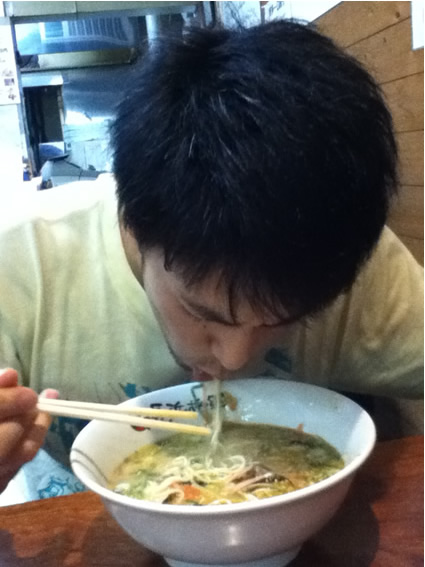
He's on to his 2nd kaedama... that means 3 loads of noodles.
Here's a tip though, if you want LOTS of noodles don't drink up your soup! That's not refillable.
Hakata Ramen in Other Parts of Japan
If memory serves me correctly, you can get Tonkotsu Ramen at some (but not all) large Ramen chain stores & restaurants, but it always depends on the store. As a Tonkotsu fan I got used to being told that there was only salt, soy and miso on the menu. Just getting Tonkotsu soup does not quite equal the Hakata experience though... if this is what you're after have a look for shops that specifically advertise Hakata or Fukuoka style Ramen. Be aware, though, that it won't taste nearly as good as the Ramen you can get all around Fukuoka as the case always is with local specialties.
Hakata or Fukuoka?
Ahh! What bugs Hakata locals even more than getting sub-par Hakata Ramen when away from home is when those sub-par Hakata Ramen are called "Fukuoka" Ramen. To a Hakata local, Hakata =/= Fukuoka. Fukuoka will have Hakata Ramen (and to a Hakata local even the noodles in Tenjin a 10 min busride away won't be getting it right) but they won't make the deadly mistake of calling it "Fukuoka style".
---------------
If the specificity and detail with which Japanese Gourmets critique cuisine surprises you, just wait till you see a gourmet that has been wronged, or a citizen whose local cuisine has been somehow misrepresented, and they work themselves up into a proper food rage.
Little wonder it's hard work to find a truly not tasty restaurant in Japan...
----
ps. My Host-mother's run in with the Udon that Shikoku is supposedly famous for turned out to be a difference in values... as Shikoku-ers appreciate udon for the texture and flavour of the noodle itself, whereas Kyushuans focus their tastebuds on the mix of noodle and soup and their taste tends towards stronger flavoured soups. You see how detailed all this gets? This is why she didn't enjoy Shikoku's udon... and for the record Hakata is rather famous for its udon too, so I guess she has a right to be fussy.
コメント(0)
トラックバック(0)
- ■この記事のURL
- https://www.gokusho.info/mt/mt-tb.cgi/197
- ■この記事にトラックバックして頂いた皆さん
- The story of Hakata Ramen from Gokusho&.


